To Read the Impossible Book
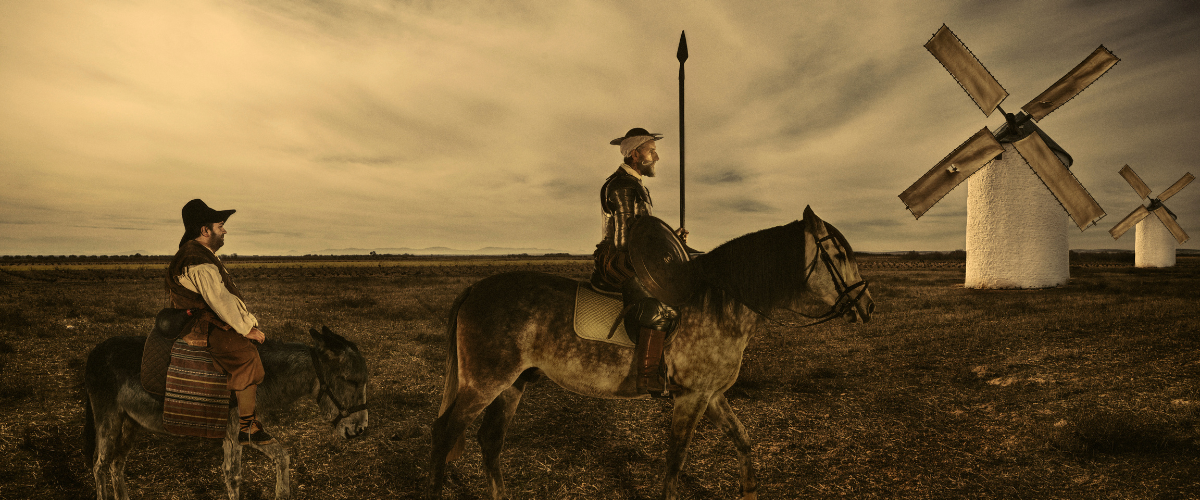
“Man of La Mancha” is one of my all-time favorite musicals. I love the music, like “The Impossible Dream,” especially the version sung by Richard Kiley from the original Broadway cast, which I saw in 1966 or so. I also love the idea of an aging knight (Don Quixote) devoted to righting the world’s wrongs no matter the odds, and his devotion to his lady, Dulcinea, even though—or perhaps especially because—she’s imaginary. It’s a transformative story of the power of hope, idealism, and imagination, of the human ability to find beauty and meaning in a harsh reality.
For several years I’ve been on a quest to read the classics of world literature, so at one point I picked up the original book upon which “Man of La Mancha” is based: Don Quixote by Miguel Cervantes, written in two parts (it is long) in 1605 and 1615, long considered a founding work of Western literature. It’s often called the first modern novel. I read both parts, paying close attention to the literary wonders all my sources assured me were there, expecting to be transported as I was by “Man of La Mancha.”
It was torture.
Besides its length—over 1,000 pages—the pacing is unbelievably slow (by modern standards), the language is archaic, the dialogue is stilted, and the characters are stiff. It’s over 400 years old, and it shows. I’d call it the world’s most famous unread book except for the fact that it’s got so much competition. And I don’t know, I guess a lot of people do still read it, but I wonder how many of them read it by choice?
We should have a whole separate category for:
Books We Hated and Only Read Out of a Sense of Duty in the First Place.
I’ve recently read other “classics” such as James Joyce’s Ulysses, which I so much wanted to love (first published by Sylvia Beach from her legendary Paris bookstore, Shakespeare & Co in 1922, and one of the most commonly banned books in the world). It supposedly offers profound insights into Irish life and the universal human condition—and, at times, in certain moments, it did, even to me. Nevertheless, its stream-of-consciousness diatribe made it absolute torment to read.
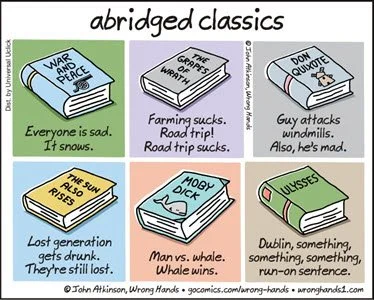
Both Don Quixote and Ulysses are considered by many critics and college professors to be two of the greatest novels of all time. All I can say is that now I better understand why, in college, I often ignored “required” or assigned reading and read whatever the hell I wanted to read, and that some of those professors “knew me better for my absence than my presence.”
And (with the exception of Hamlet and Macbeth), don’t get me started on Shakespeare.
I think, for fiction at least, I’ll stick with the likes of Dan Silva, Dan Brown, Agatha Christie, Joan Didion, J.K. Rowling, and, for the occasional change of pace, Edgar Allan Poe.
What’s the last classic you read?
Now for the real question: did you enjoy it?
EJS
March, 2026